Renewing our vision of the future
This post is a work-in-progress. Feedback is welcome!
Table of Contents
Though not directly about The Space Center, this draft resolves some of the conflicts I’ve been dealing with in previous posts like Violence in Interactive Storytelling and Nonviolence and Mechanics in Bridge Simulators. I remain convinced that hyper-reality experiences like the Space Center provide a unique environment for helping people experience The Overview Effect. Such storytelling combined with a more holistic, ecological view of our place on earth and in the stars serves as a better model of what Tomorrow could be, and how we might get there. Finally, there is a strong moral imperative (assuming preserving and continuing the infinite game of life is itself moral) for us to act now to prepare ourselves for our inevitable destiny among the stars. The sun is eventually going to kick us out of the nest - will we be ready to fly?
Have you ever felt stuck, knowing that an answer must be somewhere in the jumble of pieces before you, but you couldn’t quite figure out how to frame it? This is a universal experience from working out a jigsaw puzzle to trying to find a path forward after a natural disaster. Sometimes, there aren’t good answers and the best we can do is try to fix what might be broken. Other times, there is an answer, and the path forward becomes clear.
I’d like to argue that there is a clear path forward for some of the struggles we face as a planet and as a species. Moreover, we are at a unique moment in history to attempt to stumble in a slightly more accurate direction in whatever next steps we take.1
Before we get there, however, we need to visit Tomorrowland.
Tomorrowland Lost
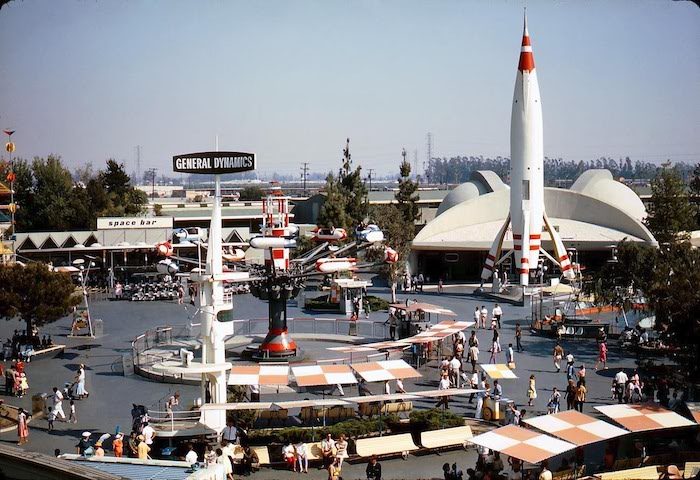
Perhaps the saddest corner of “The Happiest Place on Earth” is Tomorrowland. Other areas of Disneyland transport you to fairy tale places that are more archetypal: Haunted houses, comic relief, medieval fantasies, and swashbuckling adventure. The heroes and villains of such places live in our collective consciousness so deeply that there really are apparently only Seven Basic Plots. Tomorrowland, however, opened with a view of what might yet come to pass, leaving the door open to a future brimming with optimism, gadgets, and (of course) space travel.
I’m sure that when it opened, its vision of the future with people mover cars and space exploration was profoundly exciting and stimulating. I’ve found the best parts of Disneyland to be those more like a museum – the sort of place you go to become acquainted with the Muses of Greek antiquity. More than thrills or chills, there’s something timeless about experiencing a place that is more than real6. Certainly this would be the case in the 70s when my dad would have gone to Disneyland, road tripping through the desert without seat belts to marvel at immersion in imagination incarnate.
The experience of place and space from total immersion in an otherwise imaginary setting is profoundly evocative and even transformative for people. I know of people with various disabilities who find such escapes to be the best medicine. For anyone, getting to live in an alternate reality is one of the great delights of being human. We tell stories and spend countless billions on entertainment (and, I might add, the “nonfiction” media we consume) so that we can live out alternative lives and consider what it would be like in another pair of shoes.
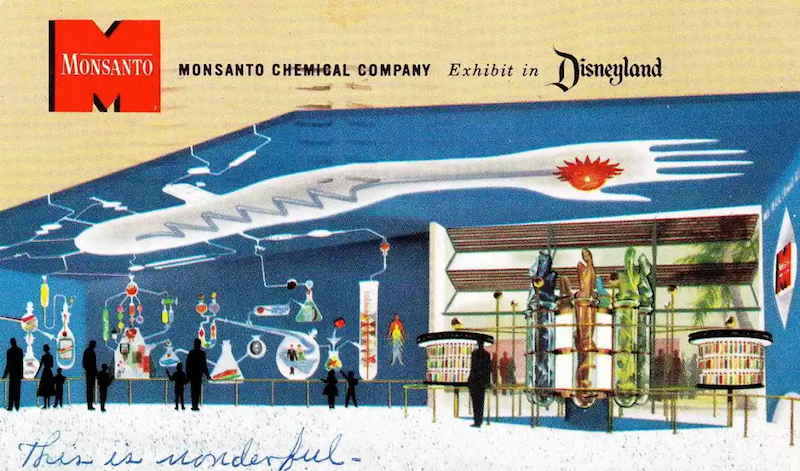
Tomorrowland, however, lost itself somewhere along the way. Frontierland embodies the mythology and legend of the American West (notwithstanding its ignorance of the grave consequences borne by nations of indigenous and first-people). Fantasyland and the other areas capture the mythology of other worlds separated by time and space, but all rooted in some retelling of history. Tomorrowland, however, attempted to create a setting where we could envision a new mythology of the future. What would the heroes of tomorrow be like? How would they achieve honor or infamy like the cast of characters we meet in the other realms of the Magic Kingdom?
Following the acquisitions of Marvel and Star Wars, Tomorrowland has become more homage to archetypal heroes in galaxies far, far away. Following this new playbook, Tomorrowland is more coherent with the other kingdoms in the park. Gone are the days asking, “What will Tomorrow be like?” Instead, it’s more of a junk drawer of science fiction dystopia, but at least there are mouse ears.
Disneyland could never keep up with the pace of technological change pouring out of Silicon Valley or other parts of the globe. That is the future we live in today, forseeable by opening the news or checking the latest Keynote from a short list of trillion-dollar corporations and their marketing teams.
Instead of seeing a mirror that projects ourselves into the forseeable future, we are more likely to meet a Storm Trooper or Darth Vader playing out that gritty Space Opera and less Space Optimism.
Gritty Space Opera
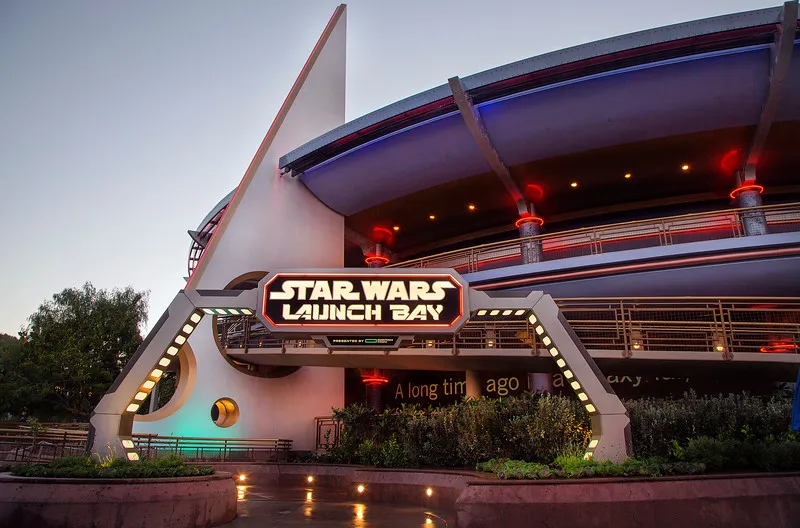
I don’t mind Star Wars.2 However, do we really want our vision of future to be captured in all-encompassing political conflict, tyrannical power concentration by shadowy elites, rooted in tariffs and pointless wars, built out of massive extraction and techno-progress-turned-superweapon? As it stands, that vision of the future has played out. But is that the future we want to be musing about when we walk around Tomorrowland?
For as campy as Meet the Robinsons” was, wasn’t that future a better one? Its portrayal in the climax of a “bad” future from mind-stealing robots is just the cartoon version of a Black Mirror episode - and that’s now satire and social commentary. With leering Meta glasses and an economy dominated by generative AI, which future do we keep on getting?
Do we really want the Mos Eisley cantina, with the only homely comforts to be had by getting as far away from other people as possible? That’s certainly the direction we’ve been heading for seemingly a long time. But is it the only way?
A Turn Toward the Stars
Since the dawn of time, living things have looked up at the stars in wonder. It’s hard for me to imagine any sentient creature with photosensitive cells not having at least some contemplation of what those little pinpricks of light are. The same stars that we gaze upon are the same stars that looked down on the dinosaurs, on the Wooly Mammoth, on the earliest fish and the most recently discovered jungle moth.3 If there is life out there with an unobstructed view of the sky4, it too gazes up at the stars and wonders, “Is there life out there?”
Until recently, looking up was all we had when it came to the heavens. We’d peer and ponder, wondering if angels or demons would come down from the heavens and give us a clue as to what it’s all about. Though Theology has yet to provide consistently reproducible evidence on that matter, we can hopefully all agree that we all share the same sky. National, ethnic, or political borders dissolve the minute we look more than a few feet above the ground we stand on – never mind 100 kilometers up, where space begins, or the unfathomable distances from here to those pinpoints of light.
Almost sixty years ago, that all changed. In the blink of an eye in the timeline of history, we went from being stuck on this rock, to walking on the one closest to us. This “giant leap” was a literal step-change in the history of humanity. We’ve also managed to send robots and probes – the vanguard of humanity – as close as our nearest neighbors. The Voyager probes have even gone as far as the Interstellar Medium (a region of space beyond the reach of the solar wind from the sun), essentially leaving the solar system.
The Future of History: An Overview
Astronauts returning from space travel often describe the transcendent experience of viewing the earth from above. This may be the only objective view we ever get of anything in our lives. Borders, barriers, and differences melt away when all you can see is the blue marble of Earth, suspended in the otherwise indifferent void of space.5
This experience is common enough to have its own name: The Overview Effect. The Overview Effect changes people and how they view the world, the people in it, and their relationship with everything. Calling it “transcendental” is not an understatement, as people report experiencing awe and wonder when gazing on the earth from above. Some astronauts “report overwhelming emotion and feelings of identification with humankind and the planet as a whole”. The Wikipedia page about it has plenty of quotes pulled from astronauts of all countries and ages describing the same basic thing: we are more alike than we are different; Earth is beautiful precious, fragile, and hopeful. “Let us preserve and increase this beauty, not destroy it!”
When traveling at 3000 kilometers per hour, it takes about 90 seconds to go from “the sky is blue” to “the sky is below you”). That goes pretty fast, and emphasizes just how fragile our atmosphere is - never mind everything living in the thin habitable zone we occupy on the surface.
Though most of us will never get to see the earth from space with our own eyes, I believe we can achieve a similar degree of transcendence when we look to the stars and contemplate what’s up and out there. We all share the same moon and the same stars, and while different corners of the world have their own unique biodiversity, we all stand on the same earth, pulled by the same gravity. We truly do have more in common than we have to divide us.
The Pale Blue Dot
Carl Sagan’s famous “Pale Blue Dot” speech was inspired by the Voyager 1 Photograph. I copy it here, in the hope that it brings just a bit of the Overview Effect to you:
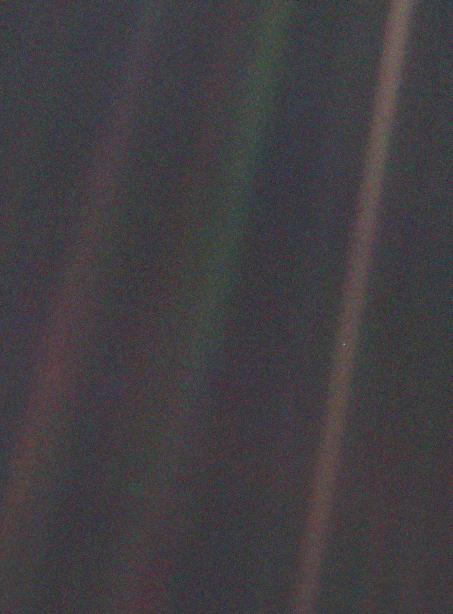
That’s here. That’s home. That’s us. On it everyone you love, everyone you know, everyone you ever heard of, every human being who ever was, lived out their lives. The aggregate of our joy and suffering, thousands of confident religions, ideologies, and economic doctrines, every hunter and forager, every hero and coward, every creator and destroyer of civilization, every king and peasant, every young couple in love, every mother and father, hopeful child, inventor and explorer, every teacher of morals, every corrupt politician, every ‘superstar,’ every ‘supreme leader,’ every saint and sinner in the history of our species lived there — on a mote of dust suspended in a sunbeam.
The Earth is a very small stage in a vast cosmic arena. Think of the rivers of blood spilled by all those generals and emperors so that, in glory and triumph, they could become the momentary masters of a fraction of a dot. Think of the endless cruelties visited by the inhabitants of one corner of this pixel on the scarcely distinguishable inhabitants of some other corner, how frequent their misunderstandings, how eager they are to kill one another, how fervent their hatreds.
Our posturings, our imagined self-importance, the delusion that we have some privileged position in the Universe, are challenged by this point of pale light. Our planet is a lonely speck in the great enveloping cosmic dark. In our obscurity, in all this vastness, there is no hint that help will come from elsewhere to save us from ourselves.
The Earth is the only world known so far to harbor life. There is nowhere else, at least in the near future, to which our species could migrate. Visit, yes. Settle, not yet. Like it or not, for the moment the Earth is where we make our stand. It has been said that astronomy is a humbling and character-building experience. There is perhaps no better demonstration of the folly of human conceits than this distant image of our tiny world. To me, it underscores our responsibility to deal more kindly with one another, and to preserve and cherish the pale blue dot, the only home we’ve ever known.
The Earth’s Climactic Moment
Fundamentally, our lonely speck in the great enveloping cosmic dark owes its entire existence to the free flow of energy from the sun. This energy, however, is itself not free, and comes at the price of entropy. This inexorable entropy is, as near as we can tell, going to exact its own death and taxes on our solar system sooner than we think. Aging stars grow in brightness and intensity by about 1% every 100 million years or so. Our best guess is that in the next 500 to 600 million years, this intensity will be too great to sustain our water cycles, photosynthesis, and the basic building blocks of life on earth as we know it. Though hundreds of millions of years truly is a very, very long time, life on this planet will cease to exist at some point in the future.
Interestingly enough, if we consider the history of all life on earth starting about 3.7 billion years ago, 500 to 600 million years from now means we are at about the 86% mark of life’s history on earth. The remaining 14% is what we are shaping today. If life were a three-act play, then we are decidedly at the climax, right now. In archetypal literature, the climax is when the hero (hopefully us) fully embraces a new truth and, by so doing, achieves decisive victory over the antagonistic force (which, truthfully, is us too). This means that we truly are at the moment when we get to choose between a happy ending and a tragic one.
Mars or other planets are still too close for comfort when our Sun finally yields to brutal entropic forces (and certainly when the sun eventually goes Nova). If Earth-origin life has any future, it will be in the stars. And yet, we will also carry with us the billions of years of evolution on this planet that will have adapted anything that survives that long to conditions on earth. Such conditions are, of necessity, part of any space travel we make. Today, this involves radiation shielding, oxygen generators and CO2 scrubbers, liquid water, and human-visible light. Our space station astronauts depend on resupply missions at least four times a year, with some supplemental fresh vegetables grown hydroponically on board.
If we look to the stars and see our inevitable future there, we will need to recreate our life on earth in whatever futuristic space capsules we cram ourselves into. Noah’s Ark was made of wood and not metal, even though I’m sure god could have figured that one out for Noah. While I’m not sure wood is the right call for the hull of a pressure vessel, is it too much to suppose that generations of space travel will go much better if, instead of feeling like a sterile operating room, we feel more like we’re in the woods? Would it be too much to hope that those woods are real and not just a holodeck?
Toward a New Tomorrowland
The Tomorrowland of yesterday promised visitors with a glimpse into what could be, and what role we might play in that future. If the shiny cellophane-wrapped future of the past has given way to a more cynical view of climate change, heat waves, and even bigger death stars, what hope might we have of carving a new mythology of the future? When so many have tried, what path forward may exist and by what light may we see it?
If the stars shed their light on such a path from above, I believe that the earth glows with its own light from below as a hint at what might be the fate of all living things on this planet. This glow is, for now, harbored in the boundless energy from our sun. In the remaining 14% of the history of earth, might we learn from the ecology that is beneath, around, inside, among, and above us? Might we learn Earth’s ways so deeply, that when the time comes for us to take flight, we are prepared to achieve that future? This is less a matter of “Wouldn’t it be cool to live on Mars?” and more a matter of bringing the dance and music of life on this planet to the broader stage of other stars. Might we learn from the dark chapters of colonialism in our history and our newspapers and, instead, see that there’s a better way for us to live here-and-now and then-and-there?
What if Tomorrowland was about reaching for the grand commons of the heavens while also firmly rooting ourselves in the ground beneath our feet? There is so much for us to learn from what we have here, so that we are prepared to make our stand in more realms than one. We have the time now to prepare for that future, unless we waste that time or accelerate ourselves into a future that we don’t actually want.
With the stars as our guide, and the dirt to ground us, what would I hope to find in tomorrow’s Tomorrowland?
- We need to stop fighting and start collaborating. Multicellular life is a testament to cooperation overcoming competition. At some point in our evolutionary tree, single-celled organisms stopped eating each other and started trading and cooperating. Eons of life later, and those cells are bound together in complex networks inside of you.7 If we’re going to make it to the stars, we need to look down at the earth, realize the borders are made up, and find ways to get along that work for everyone. I believe that a key part of this effort involves spreading the burden of governance more broadly to the edges of our markets and our systems. Working out the who and how of decision making is real work, but it is our most vital to spread, share, and federate.
- We need to balance our inputs and outputs. Nature has figured out how the waste from one process can turn into the food for another. It’s profoundly good at this in ways that we humans could learn a lot from. I don’t think we can prevent the production of waste. But, could we ask ourselves, “what waste would nature want us to produce?” Can you imagine a world where instead of signs that say “Don’t litter”, we put up signs that say “Do litter, this area could use the help!”8
- We need to cautiously bring the ecology of Earth wherever we go. As we prepare for the Artemis moon landings and a moon base, how might we re-create the ecology of earth inside our settlements elsewhere? We think of barracks and spartan living conditions (and rightfully so - getting stuff into space is really hard). But, what do we lose by bringing everything from the Earth? Might we find ways to construct shelter or produce oxygen on the moon or mars? Might we find ways to grow plants and trees? Might we find ways to construct biomes in our space craft that go beyond the pressure capsules we are familiar with from science fiction?
Post-Scarcity Sci-Fi
Star Trek famously has abundant energy and replicators that can fabricate anything a crew might want or need. Food, synthahol, tools, clothing - all of it runs through replicators. Such replicators might be possible with an incredible amount of energy, but for the time being such devices remain as realistic as faster-than-light (FTL) space travel.
Why is it, however, that FTL warp drives, replicators, and matter-antimatter reactors are easier to imagine than a space ship with a whole forest growing inside it? Could it be that we’ve been looking at space travel from the wrong direction, with our sleek, plastic-on-foam-on-metal interiors and artificial lighting? Might we, instead, envision our future in space where the post-scarcity machine is what it has been all along - the plants and animals we take for granted?
Could a fleet of vessels moving through space contain not only an ecology but an economy for all the various functions to carry out to sustain life as we voyage to the stars? Unlike the ancient mariners circumnavigating the globe, we will not be able to cast a line and hopefully catch a fish on the way. Rather, our fish will be the aquaponic support for the plants we grow for food. We will harvest fish and plant vegetables in cycles to ensure the water stays balanced along the way.
Bringing the Mythology to Us
The Space Center has played an outsized role on my thinking and view of the world for nearly thirty years. Attending as a camper was fun and exciting, as its hyper-reality offers a taste of what space travel might be like. The stories told had to be compressed to fit in an afternoon, so faster-than-light travel and automatic translation between aliens were taken for granted. Certainly no one worried about the ecological impact of antimatter reactors on the shipyards or workers building the vessels that reached for the stars. And yet, these are the concerns I have today as an adult - projections from a fantastic future on to the banal concerns of everyday adult life.
Even as projections, however, they carry weight. Just like the overview effect, when we experience something hyper-real, it changes us. Our self-concept changes. The way we relate to each other and the natural world changes. The role of great art isn’t for us to look at furniture in a painting and wonder how it would look in our front room. The role of great art is to rearrange the furniture of our own interior world. Hopefully, this also nudges us into action when we find the world out of alignment with the glimpse that art gives us of a better tomorrow.
In sharing these thoughts, my hope is twofold:
- That we consider how we might contribute to thriving in the remaining 14% of life’s history on earth.
- To nudge the stories that we tell each other and ourselves about what that future might entail.
They are both interrelated: what we do to encourage greater abundance on earth is downstream of our stories, and our stories are told about our past and the future that we hope for. Hyper-real experiences like the space center provide a stage for the latter, and hopefully inspire action in the former.
For my part, the next time I reach for a microphone to tell a story, the aim will be centered on how we might contribute to this, the climax of history on earth. Hopefully, we set the stage for a terrific sequel among the stars.
- ↩
I say “stumble” because I recognize that we’re never truly going to step purposefully. There are too many people and too many agendas, and too much friction in communicating clearly between us all. We are not machines, even though we are also more hyper social than perhaps even the busiest beehive or ant hill. Even so, this essay aims to illustrate how we might find a more unifying place in the cosmos, thanks to shared experiences in the natural world: the stars, and the dirt.
- ↩
Realistically, I probably won’t write a whole article on this. So, here’s the summary. “Rogue One” does a reasonably good job of not making any one person a hero, but instead illustrating how a nameless, federated collective of people stumbling through the fog tipped the dominoes that blew up the Death Star. Though the great icons of history (think Gandhi, Rosa Parks, or Claudette Colvin) stand as individuals, the work of those movements is not because of individuals, but because of every other “normal” person involved. Gandhi may have started the marches to the sea, but it was effective because millions of people followed and engaged in civil disobedience.
Moreover, do you think those millions would have succeeded without the invisible legions of others providing food, water, shelter, and medical aid the whole time. Likewise, the arrests of Rosa Parks and Claudette Colvin may have triggered the Montgomery Bus Boycott. However, the boycott was sustained for over a year thanks to those, nameless in history, who organized transportation, food, and other needs under the threat of violence. Mutual aid won the day, and it continues to be the quiet engine of change in the face of injustice.
We can’t comprehend individual details, so history tends to roll it all up underneath a single name (Say, Luke Skywalker). And certainly individuals can single-handedly shape history (like Vasily Arkhipov). However, we do ourselves disservice when we look for a single person to lead us when we, ourselves, can just go do the next right thing and try to nudge others to do the same.
- ↩
Yes, yes, the stars are changing and so are the constellations, all the time. Let’s not get swamped with details and forget the big picture I’m aiming at here. Back to the body of the article, please.
- ↩
There’s a pretty good chance that icy moons with warm-enough cores give rise to sub-surface liquid water oceans. Where there’s an energy gradient rich in minerals and liquid water, it would seem a decent bet that there’s life in there somewhere. Hence, life out there may not actually get to see the stars as much as we do.
Thanks to Julian Gough for introducing me to this idea.
- ↩
I would say “hostile” but the truth is that Space underwhelmingly couldn’t care less about humanity. Whatever you may believe about the purpose of life or any reason the universe might exist, the fact is that space is profoundly empty and mind-numbingly big. One might at least think it’s super cold in Space, but “cold” doesn’t mean much when there’s nothing to radiate heat into. It is certainly unpleasant, but if you took off a space suit glove in space, it’s not like your hand turns into a block of ice immediately. The experience apparently has more in common with a depressurization event when SCUBA diving and less in common with wearing a T-Shirt and shorts in a blizzard in Antarctica.
- ↩
Hyper-real if you want the best word I know for it. These experiences are what the Space Center embodies as an ideal, and is often praised for being “better than Disneyland” as a result.
- ↩
This is why “The mitochondria is the powerhouse of the cell” is actually important high school biology trivia. Your mitochondria contains its own genetic lineage that is parallel to the DNA we typically talk about. Mitochondria were themselves an early life form that collaborated enough with other life forms that they decided to move in together and share a cell wall. You are reading this because ancient cellular life learned to cooperate rather than compete. Hence, the “powerhouse” move of mitochondria isn’t just about ATP, it’s that complex life on earth began to thrive when we learned to cooperate. Early life like viruses and cyanobacteria that stuck with competition over cooperation stunted its evolutionary growth, doomed to carry itself forward by making the rest of us sick. Survival of the friendliest, not the “fittest” in the competitive sense, was perhaps the greatest evolutionary breakthrough of all time.
- ↩
I first became aware of this from the work of William McDonough